Machine Monitoring
Capture runtime, idle time, cycle counts, alarms and selected operating conditions.
Visibility
Understand what can be monitored or automated, how industrial systems connect, what implementation involves, and how to plan a dependable solution around your existing operation.
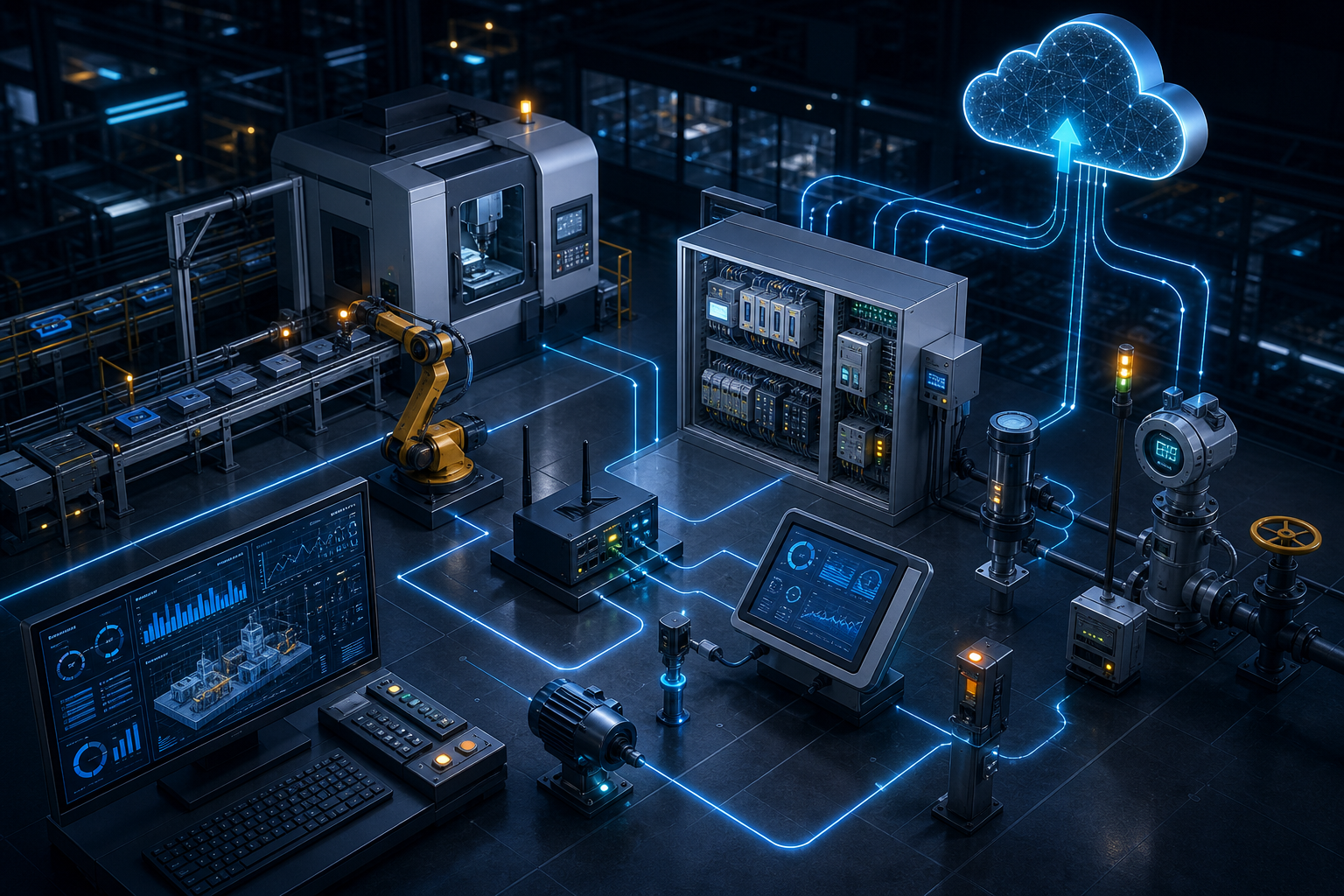
The right system combines machines, sensors, controls, networks, dashboards and people without losing sight of reliability, safety or maintainability.
Capture runtime, idle time, cycle counts, alarms and selected operating conditions.
VisibilityCoordinate sensors, actuators, PLC logic and operator controls for repeatable operation.
ConsistencyNotify responsible teams when selected thresholds, faults or events occur.
ResponseMeasure selected electrical loads and identify usage patterns or abnormal consumption.
EfficiencyRecord production events, checks, batches and process evidence where required.
AccountabilityTurn machine and process data into useful operational views and reports.
DecisionsMachine visibility, production flow, quality checks and downtime insight.
Conveyors, environment, access, material movement and utility monitoring.
Pumps, tanks, levels, pressure, energy and remote-site alerts.
Environmental sensing, irrigation, cold-chain and process monitoring.
Energy, equipment status, environment and centralized facility controls.
Edge gateways, telemetry, alerts and selected remote operations.
The exact architecture depends on control criticality, existing equipment, network policy, data needs and site conditions.
Sensors, meters, switches and machine data
PLC, relay logic and approved control devices
Local operation, status and alarms
Collection, translation and local processing
History, events, reports and integrations
Dashboards, alerts and decision support
Useful dashboards are designed around decisions, not the volume of available data.
Illustrative operational trend, not a guaranteed performance result.
Outcomes depend on process conditions, adoption, equipment health and the selected scope.
Make selected faults, stops and abnormal conditions visible sooner.
Apply repeatable approved logic and reduce avoidable variation.
Use event history and trends for maintenance and improvement discussions.
Identify selected idle operation, waste and resource-use patterns.
| Consideration | Monitoring Retrofit | Control Upgrade | New Automation System |
|---|---|---|---|
| Primary goal | Gain visibility with limited control change | Improve selected control and operator experience | Design coordinated automation from requirements |
| Existing equipment | Usually retained | Retained or selectively replaced | Architecture planned for new scope |
| Operational interruption | Typically lower, subject to survey | Requires planned change window | Planned with project commissioning |
| Best when | Need data before larger investment | Known control limitations exist | New line, process or major modernization |
| Key dependency | Safe signal access and interfaces | Documentation, compatibility and validation | Clear process and acceptance requirements |
Operational goals, pain points, users, process boundaries and success measures.
Machines, panels, signals, network, environment, safety and integration constraints.
Control philosophy, architecture, I/O, dashboards, data and rollout plan.
Validate selected machines or process areas before wider deployment.
Install, program, integrate, test and document the approved scope.
Train teams, monitor performance, support and improve over time.
Project planning should identify:
A useful first brief includes:
Often yes, using available signals, added sensors or interfaces. Feasibility and safe access must be confirmed by survey.
Not always. The recommendation depends on condition, documentation, capacity, compatibility, supportability and required changes.
Yes, local or hybrid architectures may be suitable. The choice depends on users, integrations, network policy and support needs.
Some work may require planned downtime. Survey and implementation planning identify what can be prepared offline and what needs a change window.
No. It can provide control and evidence that support improvement, but outcomes depend on the process, baseline and operational adoption.
Possibly. Integration depends on available APIs, databases, protocols, security policy and ownership of the existing systems.
Share the process, machine or facility challenge, current controls and desired outcome to receive a relevant assessment path.