Embedded Electronics
MCU selection, schematic planning, PCB coordination, sensors, power and interfaces.
Hardware foundation
Use this guide to understand the technology stack, engagement options, development stages, deliverables, production preparation and commercial decisions involved in launching an IoT or embedded product.
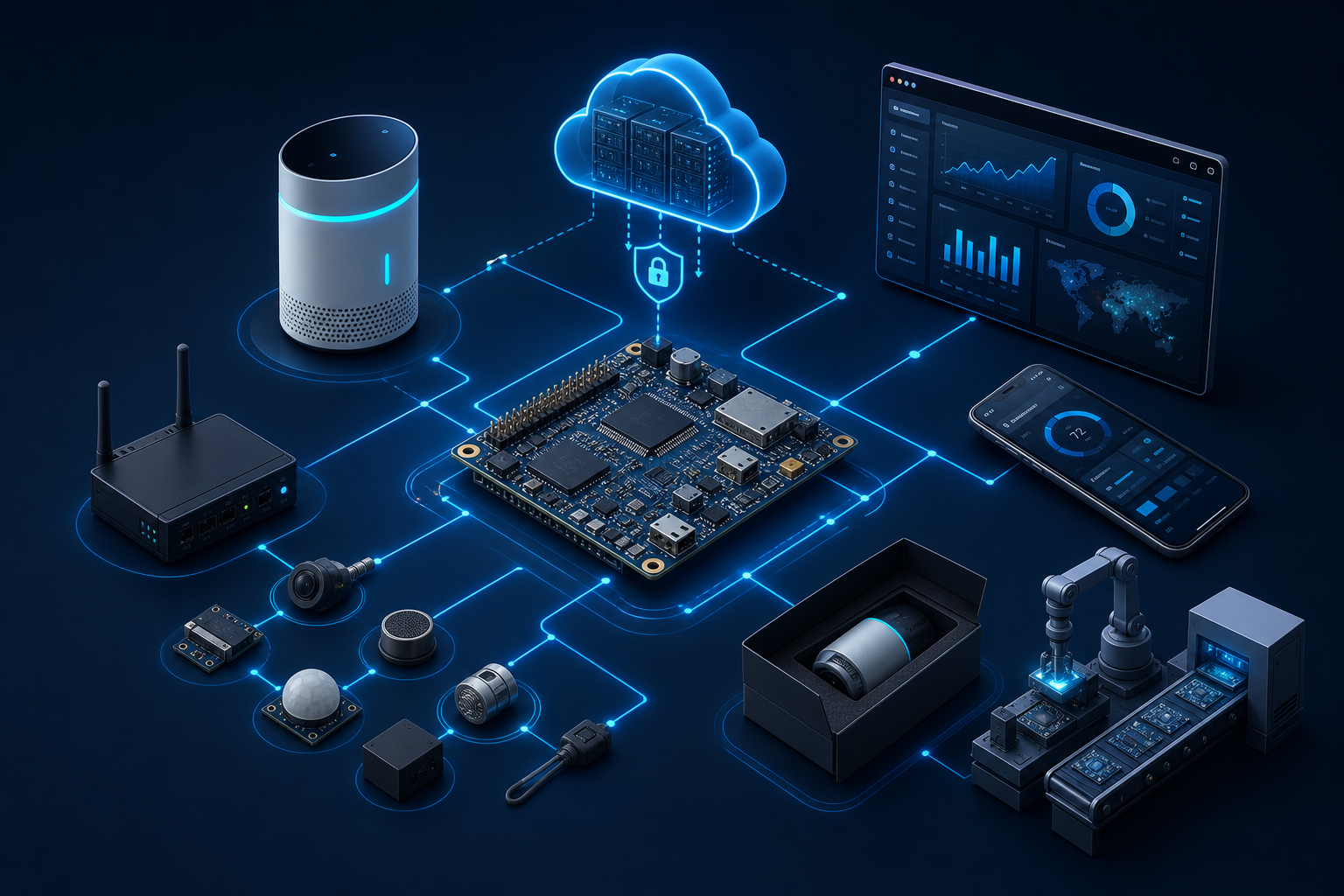
A successful connected product is more than electronics. Hardware, firmware, connectivity, applications, cloud services, manufacturing and support must be designed as one system.
MCU selection, schematic planning, PCB coordination, sensors, power and interfaces.
Hardware foundationDrivers, control logic, connectivity, diagnostics, secure updates and production firmware.
Device intelligenceWi-Fi, Bluetooth, cellular, wired protocols, gateways and device provisioning.
Connected operationDevice communication, data handling, alerts, integrations and role-based access.
Service layerWhite-label mobile experiences, operational dashboards and support tools.
User experienceBranding, packaging inputs, documentation, pilot support and production coordination.
Market readinessEach solution is shaped around its environment, customer, connectivity, safety expectations and business model.
Monitoring, alerts, machine interfaces, gateways and operational dashboards.
Controls, metering, access, safety and facility-management integrations.
Remote sensing, pump control, weather data and field connectivity.
Asset telemetry, location-aware workflows and remote diagnostics.
Connected product concepts with project-specific safety and compliance planning.
Branded connected devices, companion apps and managed device fleets.
The right model depends on differentiation, launch speed, investment, target volumes and internal engineering capability.
Adapt an eligible existing solution for your brand and market.
Modify an existing foundation around your required features and integrations.
Develop a distinct connected product from defined requirements.
Stages may overlap or repeat. Gates, acceptance criteria and deliverables are agreed for the selected engagement.
Use case, customer, operating environment, target cost and commercial intent.
Product requirement document, acceptance criteria, risks and ownership model.
Hardware, firmware, connectivity, cloud, application and security decisions.
Engineering sample, core firmware, interfaces and proof-of-function testing.
Lab tests, field pilot, reliability learning and design refinement.
BOM review, enclosure, test fixtures, documentation and production files.
Certification planning, pilot batch, training and deployment preparation.
Variants, firmware releases, issue handling and scale planning.
Early architecture choices influence most downstream cost. Prototypes and pilots create evidence before larger production commitments.
Illustrative engineering-effort pattern. Actual effort depends on scope and risk.
Exact formats, ownership, source access and acceptance conditions belong in the project agreement.
| Workstream | Prototype stage | Productization stage | Launch stage |
|---|---|---|---|
| Requirements | Use cases and priority features | Controlled product requirements | Release scope |
| Hardware | Engineering sample | Design files, BOM and production review | Approved production package as scoped |
| Firmware | Core-function build | Integrated, tested release candidate | Production release and update plan |
| Apps / Cloud | Proof-of-flow interfaces | Feature-complete scoped platform | Deployment, access and support setup |
| Validation | Functional findings | Test plans and issue closure | Pilot and launch-readiness report |
| Documentation | Discovery and architecture notes | Technical and operating documents | Partner, user and service materials as scoped |
Applicable requirements vary by product, radio technology, power source, market and intended use.
The proposal, MOU or development agreement can define:
A useful first brief includes:
Yes. Discovery can turn the idea into requirements, assumptions, risks and a recommended validation path.
It depends on novelty, complexity, certification, enclosure, integrations and validation needs. A schedule is prepared after discovery.
Ownership and access depend on the selected model and agreement. These terms should be documented before development.
Manufacturing and sourcing support can be scoped after productization. Quantities, suppliers, test method and responsibilities must be agreed.
Applicable certification must first be identified. Planning and coordination can be scoped, while external lab and authority outcomes remain independent.
Possibly. Feasibility depends on available interfaces, design access, certification impact, supplier permissions and required changes.
Share the use case, target market, key functions and expected quantity to receive the relevant OEM capability information and recommended next step.